Read more about our corporate brand here.

Operating Best Practices

Foreign exchange hedging for cross-border investments

Ivan Asensio, Ph.D., Kathy Sun Lammert, CFA

Key takeaways

  • For global funds investing internationally, FX rates may move materially during the sign-to-close period.
  • FX rate uncertainty arises from the time an international fund investment is contracted to the time the deal is funded.
  • The potential impact on the amount of US dollars (USD) that must be called can be significant.
  • Short-dated forwards can be used to help mitigate the impact of currency fluctuations during this period.

Short-dated foreign exchange (FX) forwards can be used to help minimize the FX rate uncertainty that arises between the time a global fund investment is contracted and the time the deal is funded.

The situation

A US-based global fund (“Fund”) has raised USD capital and submits a bid for an overseas asset priced in euros (EUR). The bid is accepted and will be funded three to four weeks later. Simultaneously with the acceptance of the bid, the Fund may look to make a capital call for the USD needed or instead opt to draw down from the capital call borrowing facility closer to the funding date. Either way, the amount of USD needed will change between the bid acceptance date and the date the transaction is funded.

If the EUR appreciates, more USD will be needed as the price is fixed in EUR. As a result, the Fund would need to call for more USD capital to close the transaction. This is an undesirable situation, as investors will have paid more for the asset than originally negotiated, eating into internal rate of return (IRR) and other investment performance metrics.

On the other hand, if the EUR depreciates and a capital was made on the bid acceptance date, capital will need to be returned, as fewer USD will be needed for the acquisition. Economics aside, giving capital back presents and administrative and operational burden which many times renders the windfall more trouble than it’s worth.

Why hedge?

The longer the time between deal signing and close, the more the USDs required to close the transaction will fluctuate due to FX volatility. Funds may call more USD capital than needed resulting in overfunding, or insufficient capital leading to the need to call additional funds. Both scenarios present operational challenges which can be easily addressed by hedging with short-term FX forwards.

Solution

An FX forward is a contractual obligation to exchange one currency for another at a pre-determined fixed rate and specific date in the future.

Purchase contract

The Fund agrees to pay €50.0M to acquire a European-domiciled asset priced in euro, which translates to $52.65M according to the spot rate on the day the bid is accepted and the deal is signed. Funds will be remitted in 3 to 4 weeks.

Trade details

  • EUR / USD spot reference: 1.0500
  • Direction: Buy EUR / Sell USD
  • Notional:  €50.0M
  • Contract rate: 1.0530
  • USD equivalent: $52.65M
  • Tenor: 4 weeks

Notes: Conservative (longer) tenors are advisable as it better to draw down the trade early than having to roll it forward, as the latter involves a cash event. 

Scenario analysis

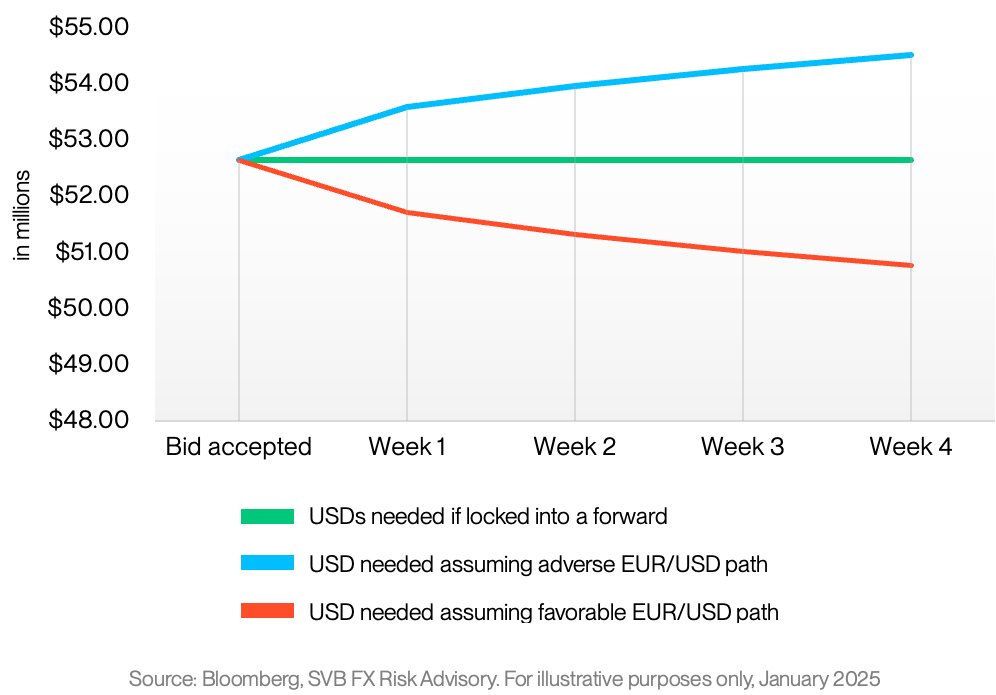
The total USD needed to close an overseas purchase can change materially over a 4-week period, from bid acceptance to deal funding. According to historical data, there is a 10 percent chance that on a €50.0M price tag, the price can change by more than $3.5M in either direction.

However, regardless of where the EUR / USD exchange rate is trading on the settlement date, according to the terms of the forward contract, the Fund will be selling $52.65M in exchange for €50.0M to make the investment.

FX Blog Chart

Additional considerations

What if the deal fails to materialize? 

A forward contract represents an obligation to buy or sell currency at a predetermined price. Should the deal fail to materialize, the Fund would need to cash-settle the forward hedge to fulfill the obligation, resulting in a gain or loss depending on spot movements during the hedge period.

What if the fund is ready to deploy capital earlier than forward settlement date?

We can accommodate early unwind of the FX forward hedge.

What if there is a delay in the expected deal close date?

There are two alternatives: 1) Settle the forward and hold euro in a multi-currency account or 2) Roll the forward for an additional week, month, etc. as required. A “roll” is a standard FX contract which requires a cash settlement.

If you’d like to discuss your specific situation or for information regarding tailored FX risk management services, reach out to your FX contact or send an email to GroupFXSalesGFB@firstcitizens.com.

Read next

Explore these related articles to help you stay on top of the latest data, insights and developments in the venture-backed crypto and blockchain ecosystem.

8 Ways to Strengthen Protection Against Funds Transfer Fraud Operating Best Practices
Read Article Article

8 Ways to Strengthen Protection Against Funds Transfer Fraud

Jul 15, 2026

Lacy Rex

Back to basics: how private funds CFOs can prepare for 2026 SEC exams Operating Best Practices
Read Article Article

Back to basics: how private funds CFOs can prepare for 2026 SEC exams

Mar 23, 2026

Annie Kong

5 cyber risk questions private funds CFOs should ask in 2026 Operating Best Practices
Read Article Article

5 cyber risk questions private funds CFOs should ask in 2026

Feb 13, 2026

Lacy Rex

Multi-year versus rolling FX hedging: What Private Funds need to know Operating Best Practices
Read Article Article

Multi-year versus rolling FX hedging: What Private Funds need to know

Sep 05, 2025

Ivan Asensio, Kathy Sun Lammert

Maximizing flexibility with NAV loans Operating Best Practices
Read Article Article

Maximizing flexibility with NAV loans

May 29, 2025

Dirk Engelbert

More about the authors

Ivan Asensio, Ph.D.

Ivan Asensio, Ph.D.

Managing Director, Head of FX Risk Advisory

Kathy Sun Lammert, CFA

Kathy Sun Lammert, CFA

Foreign Exchange Advisor


This material is for informational purposes only and is not intended to be an offer, specific investment strategy, recommendation, or solicitation to purchase or sell any security or insurance product, and should not be construed as legal, tax, or accounting advice. Please consult with your legal or tax advisor regarding the particular facts and circumstances of your situation prior to making any financial decision. While we believe that the information presented is from reliable sources, we do not represent, warrant, or guarantee that it is accurate or complete.

This information is provided for educational purposes only and should not be relied on or interpreted as accounting, financial planning, investment, legal or tax advice. First Citizens Bank (or its affiliates) neither endorses nor guarantees this information, and encourages you to consult a professional for advice applicable to your specific situation. Third parties mentioned are not affiliated with First-Citizens Bank & Trust Company.

Foreign exchange transactions can be highly risky, and losses may occur in short periods of time if there is an adverse movement of exchange rates. Exchange rates can be highly volatile and are impacted by numerous economic, political and social factors as well as supply and demand and governmental intervention, control and adjustments. Investments in financial instruments carry significant risk, including the possible loss of the principal amount invested. Before entering any foreign exchange transaction, you should obtain advice from your own tax, financial, legal, accounting, and other advisors and only make investment decisions on the basis of your own objectives, experience and resources. Opinions expressed are our opinions as of the date of this content only. The material is based upon information which we consider reliable, but we do not represent that it is accurate or complete, and it should not be relied upon as such.

This material, including without limitation to the statistical information herein, is provided for informational purposes only. The material is based in part on information from third-party sources that we believe to be reliable but which has not been independently verified by us, and, as such, we do not represent the information is accurate or complete. The information should not be viewed as tax, accounting, investment, legal or other advice, nor is it to be relied on in making an investment or other decision. You should obtain relevant and specific professional advice before making any investment decision. Nothing relating to the material should be construed as a solicitation, offer or recommendation to acquire or dispose of any investment, or to engage in any other transaction.

Banking and lending products or services are offered by First Citizens Bank. Accounts are subject to credit approval. Restrictions and limitations may apply.

First-Citizens Bank & Trust Company, as well as its divisions, subsidiaries, and affiliates (together, First Citizens), are US financial institutions and provide products and services to non-US clients on a cross-border basis from the United States of America. First Citizens is not licensed or regulated as a bank or any other type of financial institution outside of the United States of America. Please review our International Disclosures for more information.

© 2026 First-Citizens Bank & Trust Company. All rights reserved. First Citizens Bank is a registered trademark of First Citizens BancShares, Inc.

Back to top
You are now leaving First Citizens Innovation Banking

You will be directed to a different website or mobile app that has its own terms of use, visitor agreement, security and privacy policies. First Citizens Innovation Banking is not responsible for (and does not provide) any products, services or content at the third party site or app, except for the products and services that carry the First Citizens Innovation Banking name.